

- Location
- North Bay, Ontario
- Institution
- Public University
- Founded
- 1967
- Courses listed
- 16
Overview
About Nipissing University
Nipissing University College was formed in 1967 as an affiliate of Laurentian University. Nipissing University received its charter as an independent University in 1992. Today, Nipissing is proud to be a primarily undergraduate university with a reputation for excellence in teacher education, arts, science and professional programs.
Students will find themselves in a high quality academic environment that is student-focused and based on personal teaching practices, innovative approaches to learning, and a growing research culture. Nipissing is committed to playing a positive role in the educational, social, cultural and economic life in all of the communities it serves.
Why Nipissing University
- Beautiful Escarpment Campus: Nipissing University is situated on an escarpment overlooking Lake Nipissing in North Bay, Ontario. Nipissing is considered one of the safest universities in Canada. It's centrally located, just 3.5 hours north of Toronto and only 4 hours northwest of Ottawa. There are many year-round activities to enjoy, both on and off-campus. From viewing the beautiful fall colours along Duchesney Falls in September to cross-country skiing and snowshoeing in winter, students will have every opportunity to enjoy 20 kilometres of trails right on-campus. Students can sign out cross-country skis and snowshoes free-of-charge from the Athletics Centre.
- Highly-Ranked School: Nipissing is consistently ranked amongst the top in the country for: student satisfaction, student support services, residence life, mental health services, and all kinds of other student supports. Top quality programs and professors, paired with highly ranked support services, create an environment where students can thrive.
- Strong Campus Community: Nipissing offers a friendly campus and a commitment to providing one of the best undergraduate experiences among universities in Canada. Enjoy a more personalized approach to education with supportive professors and small class sizes. Take advantage of the many opportunities to get involved and explore their interests. Nipissing allows students to decide how to shape their lives and provides access to all the academic, financial, and personal support systems students need to succeed.
- Dual Degrees: Nipissing offers a wide variety of dual degrees which enable students to earn two degrees quickly. Students can combine Business with an Arts or Science program and complete a Bachelor of Arts or Bachelor of Science degree with a Bachelor of Commerce degree in as little as five years. This dual degree allows students to study a wider range of general interest and career specific subjects. Students can also choose a Concurrent Education program which leads to earning both an honours undergraduate degree and a Bachelor of Education.
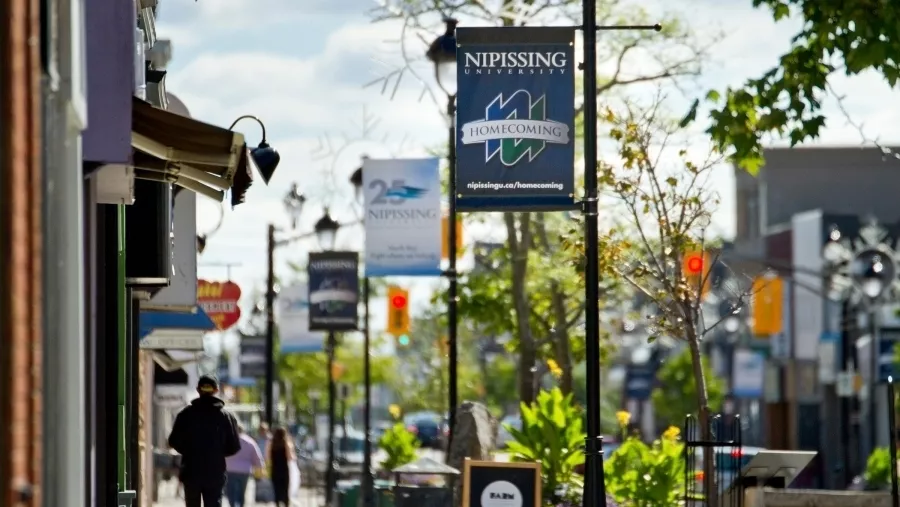
Campus life



Programs
Courses at Nipissing University
Bachelor's · Social Sciences & Psychology
Bachelor of Arts – Child and Family Studies
3 years – 4 years
Next intake: Sep 2027
Apply by 1 Apr 2027
Bachelor's · Social Sciences & Psychology
Bachelor of Arts – Child and Family Studies
3 years – 4 years Next intake: Sep 2027 Apply by 1 Apr 2027
Program Description
This program is designed for students who are fascinated with how children grow and become healthy adults, have a particular interest in learning about families and what they need to succeed, or is considering a career in developmental, behavioural, social, and/or community services where they can make a real difference.
Child and Family Studies at Nipissing University takes an interdisciplinary, lifespan approach to learning about children and adults, in the context of families and the world in which we live. It focuses on applied learning, which means making links between theory and the real world, and having opportunities to apply what's learned in the classroom to diverse community settings.
This is one of the only undergraduate programs in Canada that offers coursework and practicum placements in applied behaviour analysis and program evaluation and applied research.
Upcoming intakes: Sep 2027 · Sep 2028
Bachelor's · Computing & IT
Bachelor of Arts – Computer Science
3 years – 4 years
Next intake: Jan 2027
Apply by 1 Jan 2027
Bachelor's · Computing & IT
Bachelor of Arts – Computer Science
3 years – 4 years Next intake: Jan 2027 Apply by 1 Jan 2027
Most of people live robust digital lives. Computers are everywhere today: in phones, cars, sometimes even in refrigerators! So for students looking for a comprehensive field of study that will open up countless career opportunities, look no further—Computer Science may be just the right program.
Students will receive a first-rate education along with access to cutting-edge computer labs and technology. In addition to a strong foundation in theory, this program teaches how to apply ideas in real-world scenarios and through in-depth project-based assignments. Students may even have opportunities to solve real industry problems.
This program produces competitive graduates who have been hired in industries throughout North America including IT companies, government, education, and defense services. In addition, Nipissing Computer Science students are readily accepted into university graduate-level programs and often are sought but and secure employment before graduating from these programs.
The Bachelor of Arts - Computer Science has fewer science course requirements than the Bachelor of Science - Computer Science. Upon admission students have option to choose a 3-year degree. In a 4-year degree they must complete the practicum, while in the 3-year degree stream they will not complete the practicum.
Upcoming intakes: Jan 2027 · Sep 2027 · Sep 2028
Bachelor's · Law & Criminology
Bachelor of Arts – Criminal Justice – Corrections Stream (Including College Diploma – Community and Justice)
4 years
Next intake: Jan 2027
Apply by 1 Jan 2027
Bachelor's · Law & Criminology
Bachelor of Arts – Criminal Justice – Corrections Stream (Including College Diploma – Community and Justice)
4 years Next intake: Jan 2027 Apply by 1 Jan 2027
The School of Criminology and Criminal Justice at Nipissing examines the social, political, and economic factors that have played a part in shaping the criminal justice system from past to present. This flexible program is designed to give students a balanced combination of theory and practice. Through placements, projects, and research, students will have opportunities to work alongside criminal justice professionals.
The Corrections Corrections stream will earn students a college diploma from Canadore College and a university degree from Nipissing University in just four years. At Canadore College students will study psychology, community re-integration, programming, and interviewing, and will also complete a field placement. In the Corrections stream, students will gain skills and knowledge in areas like administration, group dynamics, and counselling.
Upcoming intakes: Jan 2027 · Sep 2027 · Sep 2028
Bachelor's · Law & Criminology
Bachelor of Arts – Criminal Justice – Criminal Justice Stream
4 years
Next intake: Jan 2027
Apply by 1 Jan 2027
Bachelor's · Law & Criminology
Bachelor of Arts – Criminal Justice – Criminal Justice Stream
4 years Next intake: Jan 2027 Apply by 1 Jan 2027
The School of Criminology and Criminal Justice at Nipissing examines the social, political, and economic factors that have played a part in shaping the criminal justice system from past to present. This flexible program is designed to give students a balanced combination of theory and practice. Through placements, projects, and research, students will have opportunities to work alongside criminal justice professionals.
In the Criminal Justice Studies stream, students will take a wide variety of courses that will give broad knowledge of the Criminal Justice system. Students will also take courses in Sociology and Psychology, and will learn how they relate to the field of Criminal Justice.
Upcoming intakes: Jan 2027 · Sep 2027 · Sep 2028
Bachelor's · Law & Criminology
Bachelor of Arts – Criminal Justice – Criminology Stream
4 years
Next intake: Jan 2027
Apply by 1 Jan 2027
Bachelor's · Law & Criminology
Bachelor of Arts – Criminal Justice – Criminology Stream
4 years Next intake: Jan 2027 Apply by 1 Jan 2027
The School of Criminology and Criminal Justice at Nipissing examines the social, political, and economic factors that have played a part in shaping the criminal justice system from past to present. This flexible program is designed to give students a balanced combination of theory and practice. Through placements, projects, and research, students will have opportunities to work alongside criminal justice professionals.
In the Criminology stream, students will learn how to understand essential theories and methodologies used in the Criminology field. This stream gives essential skills in communication, statistics, and analysis. Criminology at Nipissing regularly offers courses in special topics like Women and the Criminal Justice System, and Youth in Conflict with the Law.
Upcoming intakes: Jan 2027 · Sep 2027 · Sep 2028
Bachelor's · Law & Criminology
Bachelor of Arts – Criminal Justice – Legal Studies and Administration Stream
4 years
Next intake: Jan 2027
Apply by 1 Jan 2027
Bachelor's · Law & Criminology
Bachelor of Arts – Criminal Justice – Legal Studies and Administration Stream
4 years Next intake: Jan 2027 Apply by 1 Jan 2027
The School of Criminology and Criminal Justice at Nipissing examines the social, political, and economic factors that have played a part in shaping the criminal justice system from past to present. This flexible program is designed to give students a balanced combination of theory and practice. Through placements, projects, and research, students will have opportunities to work alongside criminal justice professionals.
Graduates from Law Clerk program from an Ontario Community College are eligible for admission to the Legal Studies and Administration Stream which includes courses in Psychology and Law, Civil Law and Civil Procedure, Law and Society, and Applied Criminological Theory
Upcoming intakes: Jan 2027 · Sep 2027 · Sep 2028
Bachelor's · Law & Criminology
Bachelor of Arts – Criminal Justice – Policing Stream (Including College Diploma – Police Foundations)
4 years
Next intake: Jan 2027
Apply by 1 Jan 2027
Bachelor's · Law & Criminology
Bachelor of Arts – Criminal Justice – Policing Stream (Including College Diploma – Police Foundations)
4 years Next intake: Jan 2027 Apply by 1 Jan 2027
The School of Criminology and Criminal Justice at Nipissing examines the social, political, and economic factors that have played a part in shaping the criminal justice system from past to present. This flexible program is designed to give students a balanced combination of theory and practice. Through placements, projects, and research, students will have opportunities to work alongside criminal justice professionals.
As a student in the Policing stream, students will examine the criminal code, the young offenders system, and learn the skills and techniques needed for a successful career in policing. Students will complete courses at both Nipissing University and Canadore College, and graduate with a college diploma and a university degree in just four years! Ethical reasoning and community policing are also key concepts in this stream.
Upcoming intakes: Jan 2027 · Sep 2027 · Sep 2028
Bachelor's · Science & Environment
Bachelor of Arts – Environmental Geography
3 years – 4 years
Next intake: Jan 2027
Apply by 1 Jan 2027
Bachelor's · Science & Environment
Bachelor of Arts – Environmental Geography
3 years – 4 years Next intake: Jan 2027 Apply by 1 Jan 2027
Geography is the interdisciplinary study of this world, its physical characteristics like water, landforms, vegetation and climate as well as the relationships between people and the environment. The Bachelor of Arts in Environmental Geography concentrates on the causes and effects of various environmental issues. Like the BA in Geography, it studies social, cultural, political, and economic geography, but has more focus on examining the causes and effects of various environment issues, including ecological degradation, climate change, pollution, and the utilization of our natural resources.
Nipissing's facilities include a state-of-the-art research wing and geomatics lab. Students collect and work with data, including digital maps, satellite imagery, and the most advanced geographic information systems (GIS) and remote sensing software. Where field research, soil, rock formation, water, and flora sampling are concerned, the campus location couldn’t be more ideal. Situated within 291 hectares of Canadian Shield forest, amid a plethora of protected natural areas, parks, important historical sites, and fresh water systems, students will find themselves perfectly positioned to study with an amazingly diverse and outdoor lab right at their doorstep.
Upcoming intakes: Jan 2027 · Sep 2027 · Sep 2028
Master's · Social Sciences & Psychology
Master of Arts – History
1 year
Next intake: Sep 2027
Apply by 15 Jan 2027
Master's · Social Sciences & Psychology
Master of Arts – History
1 year Next intake: Sep 2027 Apply by 15 Jan 2027
The Master of Arts in History program consists of course work, a Major Research Paper, and a presentation of research at the annual Graduate Student Conference. It is offered as both a one-year full-time program and on a flex-time basis. Nipissing University's program centres on the following fields: International, Gender, Canadian, European, and Environmental history. The dynamic and award-winning faculty has expertise in areas that include environmental history, the history of genocide, indigenous studies and community history, foreign relations and politics, and military history and the history of espionage.
The History department cultivates a collaborative and supportive environment where students have the opportunity to work in a meaningful capacity alongside faculty members as a teaching or research assistant. Promoting a strong community is also important to the department. The department’s History Society organizes a range of social and academic activities that brings together undergraduate and graduate students with faculty, and the department regularly hosts a seminar series to share research among university faculty and students.
Upcoming intakes: Sep 2027 · Sep 2028
Master's · Social Sciences & Psychology
Master of Arts – Sociology – Applied Social Research (Major Research Paper)
1 year
Next intake: Sep 2027
Apply by 15 Jan 2027
Master's · Social Sciences & Psychology
Master of Arts – Sociology – Applied Social Research (Major Research Paper)
1 year Next intake: Sep 2027 Apply by 15 Jan 2027
The Master of Arts (MA) in Sociology – Applied Social Research at Nipissing University is an applied social research degree focusing on the application of social theories and research methodologies that assist with understanding and addressing social problems and development challenges in northern and rural communities, including Indigenous communities. The program brings together faculty expertise in applied sociology, health and population studies, gerontology, anthropology, science and environmental studies, criminology and criminal justice, and will appeal to those with interests from across the broad range of social science and health studies disciplines. Active involvement of community and government agency partners, a curriculum of research intensive courses, and practicum placements provide students with a theoretical foundation, opportunities to hone quantitative and qualitative research skills, and occasion to sharpen evaluation and policy studies in government, not-for-profit and private sector organizations. Students will be well prepared for more advanced studies in sociology, anthropology and criminology at the doctoral level.
The Major Research Paper (MRP) will be completed during the Fall, Winter, and Summer semesters. This option is designed for those who decide to conduct library-based research, including reviews of literature and secondary analyses of data (e.g. census and survey data) that focus on social issues and policy analysis. It is intended for those who plan to seek employment opportunities as research or policy analysts/evaluators within government and/or the social services sector.
Those who choose this option will be supervised by a MRP committee that is made up of one faculty supervisor, and one consulting committee member from a government, community, or private sector organization whose experience is directly related to the student's MRP topic. They will complete a total of 18 credits, including required courses in Sociological Theory, Research Design, and either Quantitative Analysis or Qualitative Analysis, along with three additional elective courses, which may include a practicum placement with a government, community, or private agency.
It is required that applicants reach out to potential supervisors before applying to ensure they will have someone available and willing to supervise them.
The Thesis Research Project (TRP) option takes two years to complete over six semesters. It is designed for those who plan to undertake original, primary source empirical research that explores a social problem or social issue, and for those who plan to continue on to further academic studies or to work in a front-line research capacity with a community, private sector organization, or with the government. A TRP committee made up of a faculty supervisor, an additional two faculty members, and one consulting committee member from a government, community or private sector organization with experience directly related to a student's TRP topic will supervise and advise their project.
Those opting for the TRP route will complete a total of 15 credits, including required courses in Sociological Theory, Research Design and either Quantitative Analysis or Qualitative Analysis, along with two additional elective courses, which may include a practicum placement with a government, community or private agency.
It is required that applicants reach out to potential supervisors before applying to ensure they will have someone available and willing to supervise them.
Upcoming intakes: Sep 2027 · Sep 2028
Master's · Social Sciences & Psychology
Master of Arts – Sociology – Applied Social Research (Thesis)
2 years
Next intake: Sep 2027
Apply by 15 Jan 2027
Master's · Social Sciences & Psychology
Master of Arts – Sociology – Applied Social Research (Thesis)
2 years Next intake: Sep 2027 Apply by 15 Jan 2027
The Master of Arts (MA) in Sociology – Applied Social Research at Nipissing University is an applied social research degree focusing on the application of social theories and research methodologies that assist with understanding and addressing social problems and development challenges in northern and rural communities, including Indigenous communities. The program brings together faculty expertise in applied sociology, health and population studies, gerontology, anthropology, science and environmental studies, criminology and criminal justice, and will appeal to those with interests from across the broad range of social science and health studies disciplines. Active involvement of community and government agency partners, a curriculum of research intensive courses, and practicum placements provide students with a theoretical foundation, opportunities to hone quantitative and qualitative research skills, and occasion to sharpen evaluation and policy studies in government, not-for-profit and private sector organizations. Students will be well prepared for more advanced studies in sociology, anthropology and criminology at the doctoral level.
The Thesis Research Project (TRP) option takes two years to complete over six semesters. It is designed for those who plan to undertake original, primary source empirical research that explores a social problem or social issue, and for those who plan to continue on to further academic studies or to work in a front-line research capacity with a community, private sector organization, or with the government. A TRP committee made up of a faculty supervisor, an additional two faculty members, and one consulting committee member from a government, community or private sector organization with experience directly related to a student's TRP topic will supervise and advise their project.
Those opting for the TRP route will complete a total of 15 credits, including required courses in Sociological Theory, Research Design and either Quantitative Analysis or Qualitative Analysis, along with two additional elective courses, which may include a practicum placement with a government, community or private agency.
It is required that applicants reach out to potential supervisors before applying to ensure they will have someone available and willing to supervise them.
Upcoming intakes: Sep 2027 · Sep 2028
Master's · Science & Environment
Master of Environmental Sciences (Major Research Paper)
1 year
Next intake: Sep 2028
Apply by 15 Jan 2028
Master's · Science & Environment
Master of Environmental Sciences (Major Research Paper)
1 year Next intake: Sep 2028 Apply by 15 Jan 2028
Nipissing University’s Master of Environmental Science (MESc)/Master of Environmental Studies (MES) programs take a unique interdisciplinary approach by integrating ideas and methodologies from the humanities, social sciences, and natural sciences to explore and address environmental issues. The programs consist of course work plus a Major Research Paper (one-year program) or coursework plus a Thesis (two-year program). Graduate research opportunities allow students to work closely with faculty on state-of-the-art research and collaborate with community, government and industry.
With a campus located on the ancient Precambrian Shield, near the shores of Lake Nipissing and the diverse habitats of northeastern and central Ontario, students enjoy the advantages of observing and living close to the natural systems they study. Regional activities and interests related to forestry, agriculture, mining, fisheries and wildlife management, both from historical and current perspectives, can be studied.
It is highly recommended that applicants reach out to potential supervisors before applying to ensure they will have someone available and willing to supervise them.
Upcoming intakes: Sep 2028
Master's · Science & Environment
Master of Environmental Sciences (Thesis)
2 years
Next intake: Jan 2027
Apply by 1 Jan 2027
Master's · Science & Environment
Master of Environmental Sciences (Thesis)
2 years Next intake: Jan 2027 Apply by 1 Jan 2027
Nipissing University’s Master of Environmental Science (MESc)/Master of Environmental Studies (MES) programs take a unique interdisciplinary approach by integrating ideas and methodologies from the humanities, social sciences, and natural sciences to explore and address environmental issues. The programs consist of course work plus a Major Research Paper (one-year program) or coursework plus a Thesis (two-year program). Graduate research opportunities allow students to work closely with faculty on state-of-the-art research and collaborate with community, government and industry.
With a campus located on the ancient Precambrian Shield, near the shores of Lake Nipissing and the diverse habitats of northeastern and central Ontario, students enjoy the advantages of observing and living close to the natural systems they study. Regional activities and interests related to forestry, agriculture, mining, fisheries and wildlife management, both from historical and current perspectives, can be studied.
It is highly recommended that applicants reach out to potential supervisors before applying to ensure they will have someone available and willing to supervise them.
Upcoming intakes: Jan 2027 · Sep 2027 · Sep 2028
Master's · Social Sciences & Psychology
Master of Environmental Studies (Major Research Paper)
1 year
Next intake: Sep 2027
Apply by 15 Jan 2027
Master's · Social Sciences & Psychology
Master of Environmental Studies (Major Research Paper)
1 year Next intake: Sep 2027 Apply by 15 Jan 2027
Nipissing University ’s Master of Environmental Science (MESc)/Master of Environmental Studies (MES) programs take a unique interdisciplinary approach by integrating ideas and methodologies from the humanities, social sciences, and natural sciences to explore and address environmental issues. The programs consist of course work plus a Major Research Paper (one-year program) or coursework plus a Thesis (two-year program). Graduate research opportunities allow students to work closely with faculty on state-of-the-art research and collaborate with community, government and industry.
With a campus located on the ancient Precambrian Shield, near the shores of Lake Nipissing and the diverse habitats of northeastern and central Ontario, students enjoy the advantages of observing and living close to the natural systems they study. Regional activities and interests related to forestry, agriculture, mining, fisheries and wildlife management, both from historical and current perspectives, can be studied.
It is highly recommended that applicants reach out to potential supervisors before applying to ensure they will have someone available and willing to supervise them.
Upcoming intakes: Sep 2027 · Sep 2028
Master's · Social Sciences & Psychology
Master of Environmental Studies (Thesis)
2 years
Next intake: Sep 2027
Apply by 15 Jan 2027
Master's · Social Sciences & Psychology
Master of Environmental Studies (Thesis)
2 years Next intake: Sep 2027 Apply by 15 Jan 2027
Nipissing University’s Master of Environmental Science (MESc)/Master of Environmental Studies (MES) programs take a unique interdisciplinary approach by integrating ideas and methodologies from the humanities, social sciences, and natural sciences to explore and address environmental issues. The programs consist of course work plus a Major Research Paper (one-year program) or coursework plus a Thesis (two-year program). Graduate research opportunities allow students to work closely with faculty on state-of-the-art research and collaborate with community, government and industry.
With a campus located on the ancient Precambrian Shield, near the shores of Lake Nipissing and the diverse habitats of northeastern and central Ontario, students enjoy the advantages of observing and living close to the natural systems they study. Regional activities and interests related to forestry, agriculture, mining, fisheries and wildlife management, both from historical and current perspectives, can be studied.
It is highly recommended that applicants reach out to potential supervisors before applying to ensure they will have someone available and willing to supervise them.
Upcoming intakes: Sep 2027 · Sep 2028
Master's · Science & Environment
Master of Science – Mathematics (Thesis)
2 years
Next intake: Sep 2027
Apply by 15 Jan 2027
Master's · Science & Environment
Master of Science – Mathematics (Thesis)
2 years Next intake: Sep 2027 Apply by 15 Jan 2027
The Master of Science in Mathematics program consists of course work plus a Major Research Paper (MRP) or Thesis. The Thesis route is available as a two-year (6 term) full-time program. Nipissing University's program trains students for future work in research, industry, business, or government, and provides a strong background in foundational areas of mathematics. The faculty members are experts in topology, analysis, combinatorics and graph theory, industrial and applied mathematics, with research in scheduling, computational problems, numerical mathematics, and optimization. Many faculty work on inter- and multi-disciplinary research in geography, the physical and health sciences, business, and management, to name only a few. Graduate students therefore also have an opportunity to perform research on the interface of mathematics and other disciplines.
The thesis route requires students to become more deeply proficient in an area of mathematics than is standard in an MRP. A thesis is generally (depending on the topic) longer and more detailed than an MRP. Because of its more advanced nature, a thesis requires more time to complete than an MRP. Additionally, a thesis generally (but not always) contains multi- and inter-disciplinary aspects, and will usually involve research into advanced areas of mathematics and computational science.
Upcoming intakes: Sep 2027 · Sep 2028
No courses match your search.
Student life & support
Work while studying
International students can work part-time alongside their studies (subject to visa conditions).
Co-op & placements
Co-op options are limited — ask us about placement-friendly alternatives.
On-campus housing
Students typically arrange off-campus or homestay accommodation.
Accommodation options
Students need to plan their accommodations well in advance of their arrival as all accommodation options fill up quickly, well before the start of the semester.
On-Campus Residence Accommodations
On-Campus residence accommodations are provided per discretion by the school.
Off-Campus Accommodations
The local area has a variety of off-campus rental housing options including single homes, duplexes, apartments and rooms for rent. Students wishing to live off-campus need to research availability on their own and should arrive well before the start of term to do so.
Homestay
There are a wide variety of homestay options available, and our partners do their best to match students and hosts according to their interests and preferences. Homestay hosts include single people, young couples with children and pets, and older couples. All homestay accommodations have been inspected, and all adults in the home have completed a required criminal reference check.