

- Location
- Winnipeg, Manitoba
- Institution
- Public University
- Founded
- 1877
- Courses listed
- 10
Overview
About University of Manitoba
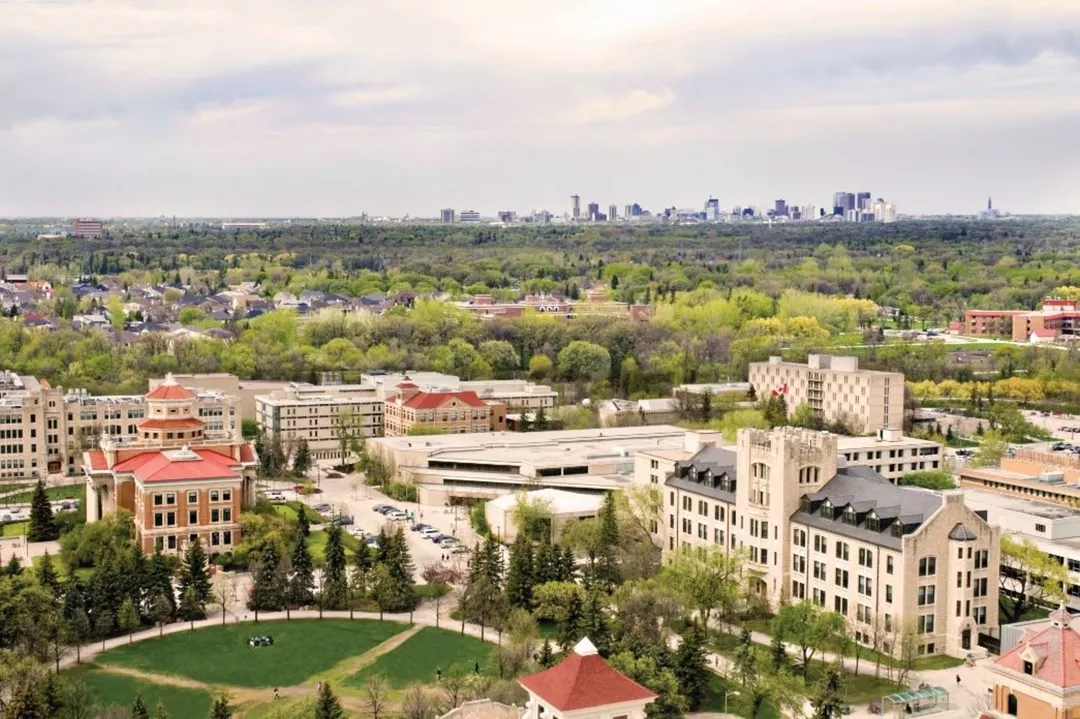
The University of Manitoba, located in Winnipeg, Manitoba, attracts people from around the world who share the same ideals and vision for positive change. The University of Manitoba believes in embracing challenges and taking action. Students, researchers and alumni alike bring their unique voices to learning and discovery, shaping new ways of doing things and contributing to important conversations in topics that matter most, from human rights to global health to climate change. Here is where imagination and action collide. The University of Manitoba is Western Canada’s first university, established in 1877, and located on original lands of Anishinaabeg, Cree, Oji-Cree, Dakota, and Dene peoples, and on the homeland of the Métis Nation. The University is Manitoba's only research-intensive university, and one of the country’s top research institutions. There are more than 29,000 undergraduate and graduate students, and more than 145,000 alumni living in 140 countries.
The University of Manitoba's mission is to create, preserve, communicate and apply knowledge, contributing to the cultural, social and economic well-being of the people of Manitoba, Canada and the world. The school's vision is to take its place among leading universities through a commitment to transformative research and scholarship, and to innovative teaching and learning - uniquely strengthened by Indigenous knowledge and perspectives. To achieve its vision, the school requires a commitment to a common set of ideals. The University of Manitoba values: Academic Freedom, Accountability, Collegiality, Equity and Inclusion, Excellence, Innovation, Integrity, Respect, and Sustainability. At the University of Manitoba, students will be challenged to grow, inspired to create and dared to excel. Wherever life takes students after graduation, they will be able to apply what they learned, both personally and academically, to make a real-life impact. The future begins right here.
Why the University of Manitoba
- Innovative Teaching: The University has garnered eight Synergy Awards for Innovation, established by the Natural Sciences and Engineering Research Council of Canada to recognize outstanding university-industry collaboration.
- Indigenous Culture: The University of Manitoba welcomed over 2,500 First Nations, Métis and Inuit students, including more than 200 graduate students. It is the home to one of the largest Indigenous student populations in Canada.
- Facilities: The on-campus Active Living Centre provides the community with a state-of-the-art fitness facility and research opportunities to help Manitobans create healthier lifestyles.
- Libraries: Across 19 locations, the University of Manitoba's libraries house more than 2.9 million items, and offer access to 75,000-plus print and electronic journals, and over 1.1 million e-books.
Campus life
Programs
Courses at University of Manitoba
Bachelor's · Law & Criminology
Bachelor of Arts – Criminology (Program Major)
3 years – 4 years
Next intake: May 2027
Apply by 1 Feb 2027
Bachelor's · Law & Criminology
Bachelor of Arts – Criminology (Program Major)
3 years – 4 years Next intake: May 2027 Apply by 1 Feb 2027
Criminology is concerned with the complex social phenomena of crime and criminalization. The criminology program engages students in a systematic study of the nature and extent of crime and criminalization along with the array of agencies and programs designed to prevent, control, and respond to criminal activity over time and place. Attention is given to specific issues related to gender, race, class and crime, youth and crime, violence and victimization, criminal law and procedure, policing and crime prevention, restorative justice, and global criminology. Courses in the criminology program are taught primarily from a sociological perspective, with emphasis placed on research, program development, and policy analysis.
Professional opportunities:
- Law enforcement
- Corrections
- Probation or parole
- Criminal justice administration
- Crime prevention
- Private security
- Youth and child care counsellors
- Private sector social research
- Government policy research and analysis
Upcoming intakes: May 2027 · Sep 2027 · Jan 2028
Bachelor's · Science & Environment
Bachelor of Arts – Geography (Advanced Entry)
3 years – 4 years
Next intake: May 2027
Apply by 1 May 2027
Bachelor's · Science & Environment
Bachelor of Arts – Geography (Advanced Entry)
3 years – 4 years Next intake: May 2027 Apply by 1 May 2027
Human Geography concentrates on the relationships University Of Manitoba societies have with the places and landscapes they inhabit. Geography students understand how human societies, cultures and economies work and how those systems are interdependent with the physical environment.
Areas of employment for geography graduates include:
- municipal, provincial and federal government
- community economic development agencies
- city or regional planning firms
- social and community service organizations
- parks and recreation departments
- international development organizations
- educational institutions
- cultural resource management agencies
- transportation planning departments
- agricultural and environmental consulting firms
- travel and tourism industry
- environmental boards and commissions
- environmental non-governmental
- organizations (ENGO’s)
- scientific foundations and policy institutes
A Bachelor of Arts in Geography provides students with the opportunity to focus in one of three academic streams:
- Resources, Environment and Society (RS): Students in this stream focus on the geographies of natural and human induced environmental processes in the recognition that current environmental change shapes relationships across all scales of society.
- Global Politics, Justice, and Sustainability (GPS): Students in this stream study geography on a global scale through an integrated assessment of the links between the economic, socio-cultural, ecological and political systems that combine to shape the world they live in.
- Culture, Identity and Space (CIS): Students in this stream study geography with an emphasis on the dynamics between identity, culture and landscapes, with a particular focus on cooperation and conflicts that produce local landscapes.
Upcoming intakes: May 2027 · Sep 2027 · Jan 2028
Bachelor's · Science & Environment
Bachelor of Arts – Geography (Direct Entry)
3 years – 4 years
Next intake: May 2027
Apply by 1 Feb 2027
Bachelor's · Science & Environment
Bachelor of Arts – Geography (Direct Entry)
3 years – 4 years Next intake: May 2027 Apply by 1 Feb 2027
Human Geography concentrates on the relationships people's societies have with the places and landscapes they inhabit. Geography students understand how human societies, cultures and economies work and how those systems are interdependent with the physical environment.
Areas of employment for geography graduates include:
- municipal, provincial and federal government
- community economic development agencies
- city or regional planning firms
- social and community service organizations
- parks and recreation departments
- international development organizations
- educational institutions
- cultural resource management agencies
- transportation planning departments
- agricultural and environmental consulting firms
- travel and tourism industry
- environmental boards and commissions
- environmental non-governmental
- organizations (ENGO’s)
- scientific foundations and policy institutes
Upcoming intakes: May 2027 · Sep 2027 · Jan 2028
Bachelor's · Social Sciences & Psychology
Bachelor of Arts – Linguistics (Program Major)
3 years – 4 years
Next intake: May 2027
Apply by 1 Feb 2027
Bachelor's · Social Sciences & Psychology
Bachelor of Arts – Linguistics (Program Major)
3 years – 4 years Next intake: May 2027 Apply by 1 Feb 2027
Linguistics is the study of how human language is structured, acquired and used, how it changes over time, and how words and constructions mean what they do in human interaction. The program offers courses in a wide variety of the sub-fields of linguistics: the nature of meaning, sounds and patterns of sounds, the structure of words and sentences, anatomical foundations of language, historical linguistics, the role of language in society, signed language, and the relationship between language and gender.
The Linguistics program and its faculty offers students a range of theoretical perspectives and practices, including generative, cognitive, functional, and typological approaches to language. The program specializes in both spoken and signed language linguistics, with a particular focus on local, primarily indigenous languages. The department also houses the ASL/English Interpretation Program, a joint program with Red River College.
Upcoming intakes: May 2027 · Sep 2027 · Jan 2028
Bachelor's · Data & Analytics
Bachelor of Commerce – Actuarial Mathematics (Program Major)
4 years
Next intake: Sep 2027
Apply by 1 Mar 2027
Bachelor's · Data & Analytics
Bachelor of Commerce – Actuarial Mathematics (Program Major)
4 years Next intake: Sep 2027 Apply by 1 Mar 2027
The actuarial profession involves the application of mathematical disciplines; particularly probability, statistics and risk theory, to real life financial problems involving future uncertainty. The analysis involved helps people and organizations plan for and reduce financial risk in diverse areas such as life, health, disability, property and casualty insurance, annuities, pension plans and employee benefit plans.
Students in the Actuarial Studies major:
- are required to take the same business core courses as in other majors providing the opportunity to study other business-related areas
- can take as little as four actuarial courses to claim their major in actuarial mathematics
- have access to the business library that provides updated study materials that help students prepare for professional actuarial exams
Upcoming intakes: Sep 2027 · Sep 2028
Bachelor's · Business & Management
Bachelor of Commerce – Logistics and Supply Chain Management (Optional Co-op) (Program Major)
4 years – 52 months
Next intake: Sep 2027
Apply by 1 Mar 2027
Bachelor's · Business & Management
Bachelor of Commerce – Logistics and Supply Chain Management (Optional Co-op) (Program Major)
4 years – 52 months Next intake: Sep 2027 Apply by 1 Mar 2027
By studying logistics and supply chain management, students will examine and tackle issues that relate to procurement, strategic outsourcing and making trade-offs for the benefit of the supply chain.
Supply chain management is an integrated management of the flow of products, services and information from suppliers, through operations to the final customer.
The Logistics and Supply Chain Management major examines issues such as:
- Developing trust and long-term partnerships
- Making trade-offs for the benefit of the entire supply chain
- Meeting end-customer requirements
- Determining the best combinations of transportation modes
- Strategic outsourcing and procurement
Upcoming intakes: Sep 2027 · Sep 2028
Bachelor's · Arts, Media & Design
Bachelor of Environmental Design (Advanced Entry)
4 years
Next intake: Sep 2027
Apply by 1 Mar 2027
Bachelor's · Arts, Media & Design
Bachelor of Environmental Design (Advanced Entry)
4 years Next intake: Sep 2027 Apply by 1 Mar 2027
The Bachelor of Environmental Design program is a strong multidisciplinary undergraduate degree that provides a solid base of design education for students intending to pursue careers or graduate studies in a wide variety of disciplines, including the Faculty's master's degrees in Architecture, City Planning, Interior Design and Landscape Architecture, and at other institutions globally.
The Environmental Design curriculum is structured around a design studio sequence that provides a forum for exploring the complex relationships between humans and the natural and built environments that constitute the places and artifacts of cultural production. Over a four-year period, students will develop the necessary knowledge and skills to pursue work in a wide variety of design practices.
The Bachelor of Environmental Design Degree (BEnvD) is a four-year program consisting of two years of common foundation studies, followed by two years of pre-professional intermediate studies in one of three areas of focus: Architecture, Interior Environments, or Landscape + Urbanism.
Upcoming intakes: Sep 2027 · Sep 2028
Master's · Business & Management
Master of Finance (Optional Co-op)
1 year
Next intake: Sep 2027
Apply by 1 Mar 2027
Master's · Business & Management
Master of Finance (Optional Co-op)
1 year Next intake: Sep 2027 Apply by 1 Mar 2027
The Asper Master of Finance (MFin) is a CFA Institute University Affiliation Program. It is a comprehensive one-year, three-term program that prepares students to write all three levels of exams needed to obtain a Chartered Financial Analyst (CFA) designation, with a focus on the Level 1 exam. The program has been mapped to align with the CFA Program Curriculum. Asper Master of Finance students gain accredited, ethics-based academic training that prepares them for a professional career in the financial services sector.
Upcoming intakes: Sep 2027 · Sep 2028
Master's · Business & Management
Master of Supply Chain Management and Logistics (Optional Co-op)
2 years
Next intake: Sep 2027
Apply by 1 Mar 2027
Master's · Business & Management
Master of Supply Chain Management and Logistics (Optional Co-op)
2 years Next intake: Sep 2027 Apply by 1 Mar 2027
Meet the growing global demand. Pursue a Master of Supply Chain Management and Logistics in Winnipeg, Manitoba - Canada's hub for transportation and logistics. This professional master’s program is designed to prepare students for leadership positions within the broad field of supply chain management and logistics.
The Master of Supply Chain Management and Logistics program delivers supply chain management and logistics education and advanced professional skills while guiding students in developing their understanding of and appreciation for the application of ethics, sustainability and professional practices in supply chains.
This program is a hands-on degree with a practical component, which gives students the skills and knowledge required to work professionally in supply chain management and logistics fields.
Upcoming intakes: Sep 2027 · Sep 2028
MBA · Business & Management
Master of Business Administration (Optional Co-op)
1 year – 2 years
Next intake: Sep 2027
Apply by 28 Feb 2027
MBA · Business & Management
Master of Business Administration (Optional Co-op)
1 year – 2 years Next intake: Sep 2027 Apply by 28 Feb 2027
Established in 1968 and accredited by AACSB in 1999, the Asper MBA maintains a tradition of quality instruction and mentorship in business fundamentals, decision-making methods and essential leadership strategies.
Each MBA student has unique goals and each industry and sector demands different expertise from its leaders. The Asper MBA program is designed to meet the market-driven needs of today’s industry professionals.
Students will benefit from the experiential approach to learning. Tackle real issues and develop tangible solutions for businesses in University of Manitoba and across the globe.
Experiential learning opportunities include international study trips, live industry projects, complex global market simulations and international case competitions.
The Asper MBA program design will arm students with the skills, knowledge and experience they need to excel in today’s business world.
Upcoming intakes: Sep 2027 · Jan 2028 · Sep 2028
No courses match your search.
Student life & support
Work while studying
International students can work part-time alongside their studies (subject to visa conditions).
Co-op & placements
Offers co-op or work-placement options in selected programs.
On-campus housing
On-campus residence is available.
Accommodation options
Students need to plan their accommodations well in advance of their arrival as all accommodation options fill up quickly, well before the start of the semester.
On-Campus Residence Accommodations
On-Campus residence accommodations are provided per discretion by the school.
Off-Campus Accommodations
The local area has a variety of off-campus rental housing options including single homes, duplexes, apartments and rooms for rent. Students wishing to live off-campus need to research availability on their own and should arrive well before the start of term to do so.
Homestay
There are a wide variety of homestay options available, and our partners do their best to match students and hosts according to their interests and preferences. Homestay hosts include single people, young couples with children and pets, and older couples. All homestay accommodations have been inspected, and all adults in the home have completed a required criminal reference check.